
Insurance in Miami: what home, flood and auto coverage actually cost a newcomer
Last reviewed: November 8, 2026. Sources for this page are listed in its fact sheet.
Short answer first. Budget for three separate bills, because Florida splits what other states bundle. Homeowners insurance runs into the thousands a year, flood is a second policy that a standard homeowners policy does not include, and car insurance costs about double the national pattern. Two published averages for home insurance disagree by about $4,500, and both are printed below with their methods attached, because the gap is the story. One warning before the numbers: Florida did not repeal its no-fault car insurance law in 2026, whatever a quote site told you. PIP is still required. Details are in the auto section.
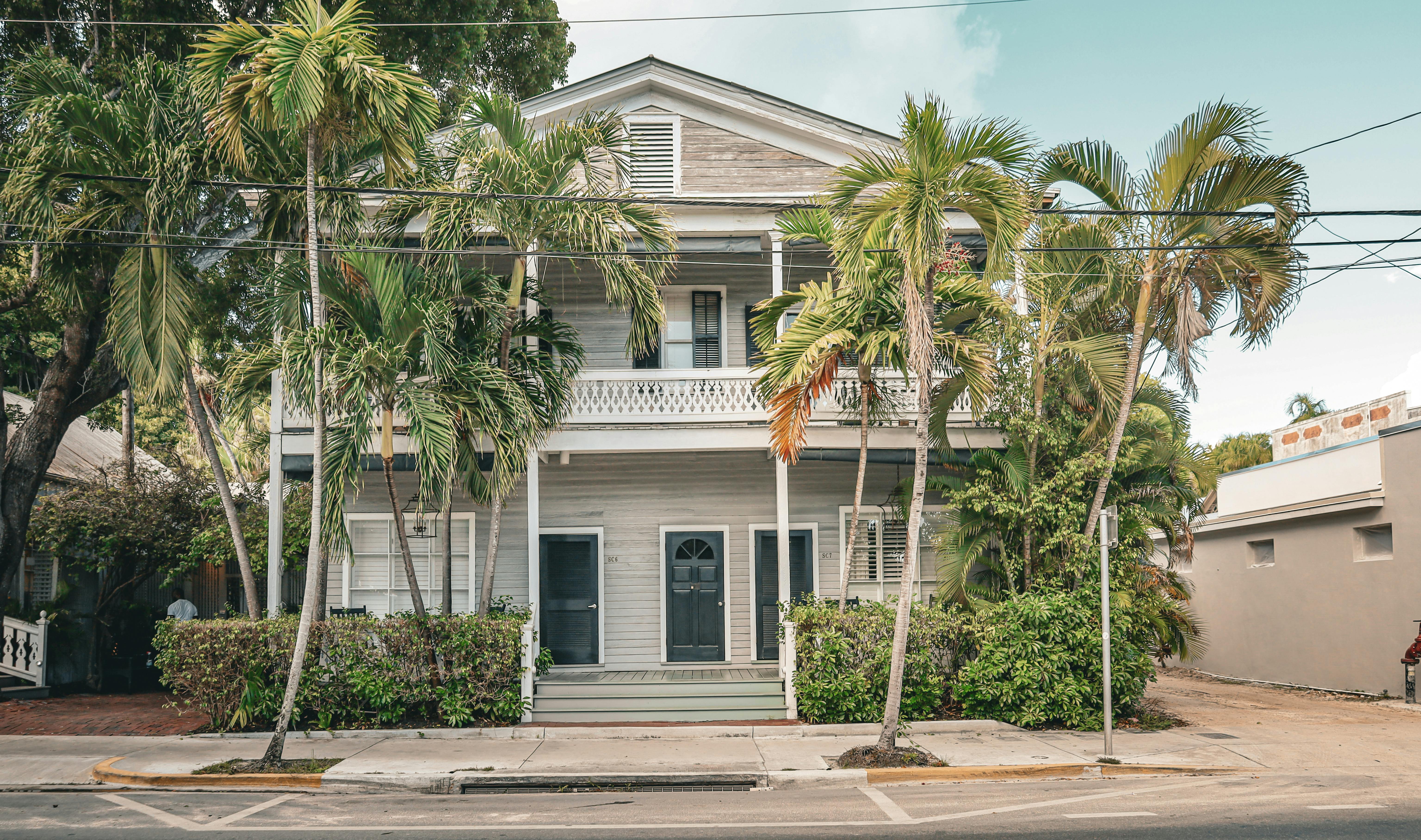
A Florida house with palm trees, in Key West. Stock photo, not a Miami property. Photo: Arian Fernandez, Pexels.
The two home insurance averages, and why they disagree
The Florida Office of Insurance Regulation's market figures, reported in the Florida press in early 2026, put the state's actual average homeowners premium at about $3,800 a year, including wind coverage. That number is arithmetic, not marketing: total premiums in force divided by total policies in force across the whole Florida market, including the cheap inland policies and the state-backed Citizens book. Insurify's 2026 report on American homeowners puts Florida's average at $8,292 for 2025, up 18 percent over 2024, with a projection of $8,458 for 2026. That number comes from Insurify's own quote database, which skews toward people actively shopping, often because their renewal just jumped.
Neither figure is your quote. Miami-Dade sits at the expensive end of the state market, and a coastal condo or an older roof can price above both. Use the OIR figure to understand the market and the Insurify figure to understand what shoppers are being quoted, then get your own number for your own address before you sign a lease or a contract. A premium guessed from a national article is how a monthly budget breaks in month two.
The direction of the market in 2026
Rates are easing at the state level, slowly. Citizens Property Insurance, the state-backed insurer, won approval for 2026 rates with a statewide average decrease of 8.7 percent, taking effect as policies renew from spring 2026. More than 330,000 Citizens policyholders get a decrease, and more than 150,000 get 10 percent or more. In Miami-Dade, about 42,000 homes get a decrease averaging 14.0 percent. Private carriers filed decreases or flat renewals through late 2025 as well. That is relief at the margin, not a return to cheap. It is also a reason to re-shop at every renewal instead of auto-paying the first bill you were handed at closing.
The hurricane deductible: a cash reserve, not a monthly cost
Florida homeowners policies carry a separate deductible for hurricane losses, and it is a percentage of the home's insured value, not a flat $500. Insurers must sell the options of $500, and 2, 5, and 10 percent of the dwelling limit (on homes insured for $250,000 or more, the $500 option does not have to be sold). The deductible is triggered when the National Hurricane Center declares a storm a hurricane, and the window runs from the first hurricane warning for any part of Florida until 72 hours after the last watch or warning ends. It applies once per calendar year, and when it applies, no other deductible on the policy applies to that loss.
Run your own math before you pick a percentage. Two percent of a $500,000 dwelling limit is $10,000 out of your pocket before the insurer pays a dollar of hurricane damage. Five percent is $25,000. The lower premium on a 5 or 10 percent deductible is real money every quiet year, and a real problem in the bad week. Most newcomers are better served holding the reserve the deductible demands, in cash, from the first month. Our first 90 days checklist puts that reserve on the settling calendar.
Wind mitigation: the inspection that pays
Florida law requires insurers to give actuarially sound discounts or credits for construction that resists wind: roof shape and covering, opening protection, straps and clips, and similar work. The proof is a uniform mitigation verification inspection, recorded on the state's inspection form (OIR-B1-1802) by a qualified inspector and sent to your insurer, which then sets the credit. On an older Miami home the credit can be worth hundreds a year, and the inspection itself is a one-time cost in the low hundreds. Ask for the inspection before you bind the policy if the home has never had one, and keep the form. It travels with your file at every renewal and every carrier switch.
Flood is a separate policy, and it starts 30 days late
A standard homeowners policy does not cover flood. Full stop. Coverage runs through the National Flood Insurance Program or a private flood policy, with NFIP limits of $250,000 on the building and $100,000 on contents for a home, and contents-only cover up to $100,000 for renters. Most NFIP policies take effect 30 days after purchase, which is why the flood decision belongs in the first week of a move, not the week a storm forms. Whether your address needs it is a map question, and our address flood and surge check walks the three lookups in order. Lenders require flood insurance on federally backed mortgages in the high-risk zones; outside those zones it is your call, and the claims data argues for taking it seriously either way.
Auto insurance: PIP is still the law, and the repeal story is false
Florida's no-fault law requires every vehicle registered in Florida to carry at least $10,000 of personal injury protection (PIP) and $10,000 of property damage liability (PDL), in force through the whole registration period. Florida insurance has to be in place before the state will register the car, which is why insurance is step one in our license and plates sequence. You may see articles claiming Florida replaced PIP with mandatory bodily injury limits of $25,000 and $50,000 on July 1, 2026. That change was a bill, HB 1181 in the 2025 session, and the Florida House's own record shows it died in committee on June 16, 2025. It never became law. FLHSMV's current pages still state the $10,000 PIP and PDL requirement.
Full coverage costs far more here than in most states. Bankrate's published research puts Florida full coverage at $3,874 a year on its August 2025 data, and newcomers with no US driving record or a Miami garaging address can be quoted above that. One more number explains the quotes: about one in five Florida drivers, 20.6 percent in 2023 per the Insurance Research Council, carries no insurance at all, against 15.4 percent nationally. Uninsured motorist coverage is the line that answers that fact, and it is worth a plain conversation with the agent instead of a declined checkbox.
Quote preparation checklist
Quotes move faster, and come back lower, when the file is complete. For a home: the roof's age and material, any opening protection and its documentation, the mitigation inspection form if one exists, the prior owner's claim history if the seller discloses it, and the exact flood zone from the county lookup. For a car: the garaging ZIP, the drivers and their license history, the annual mileage you honestly expect, and the coverage limits you are comparing, held identical across quotes so the prices mean something. Two safety items pay for themselves in this market and sit in the mitigation file as well: carbon monoxide detectors and water leak alarms, both cheap, both the kind of loss prevention insurers ask about.
The facts that matter
Insurance facts checked November 8, 2026: OIR market average about $3,800 a year including wind (premiums in force divided by policies in force, reported early 2026); Insurify average $8,292 for 2025 from its quote database. Citizens 2026 approved rates average -8.7 percent statewide, with about 42,000 Miami-Dade homes averaging -14.0 percent. Hurricane deductible options are $500, 2, 5, and 10 percent of the dwelling limit, triggered by a National Hurricane Center hurricane declaration; 2 percent of $500,000 is $10,000. NFIP limits are $250,000 building and $100,000 contents, renters contents to $100,000, with a standard 30 day wait. Auto minimums are $10,000 PIP and $10,000 PDL (FLHSMV); the claimed July 1, 2026 PIP repeal was HB 1181 (2025), which died in committee on June 16, 2025.
Frequently asked questions
Which average should I budget with?
Neither, directly. Get a quote on the actual address. Until then, budget above the OIR market figure if the home is coastal, older, or a condo in a large association, because all three push Miami-Dade quotes up.
Do renters need flood insurance?
A landlord's policy does not cover your belongings. Contents-only flood cover runs to $100,000 through the NFIP, and the 30 day wait applies to renters too, so the purchase belongs at move-in.
Can I register my car first and insure it after?
No. Florida insurance has to be in force before registration, and it has to stay in force through the registration period.
Keep planning
Next steps: the flood, surge and elevation check for any finalist address, the condo three-document check before an offer, the true monthly cost worksheet, and the moving to Miami hub.