
Your first hurricane season in Miami: the newcomer shopping and setup guide
Last reviewed: November 8, 2026. Sources for this page are listed in its fact sheet.
Short answer first. Buy the kit in January, not in the cone week. Hurricane season runs June 1 to November 30, and the state's own baseline is enough non-perishable food and water for at least seven days per person, per the Florida Division of Emergency Management. Newcomers get two advantages locals have forgotten about: empty January shelves are full ones, and since August 1, 2025, the core disaster supplies are permanently exempt from Florida sales tax, so the saving is available on any ordinary Tuesday. This page works the kit room by room, marks which items carry the exemption, and closes with the setup steps, county alerts, document scans, and the generator rule, that no shopping trip can fix in a storm week.
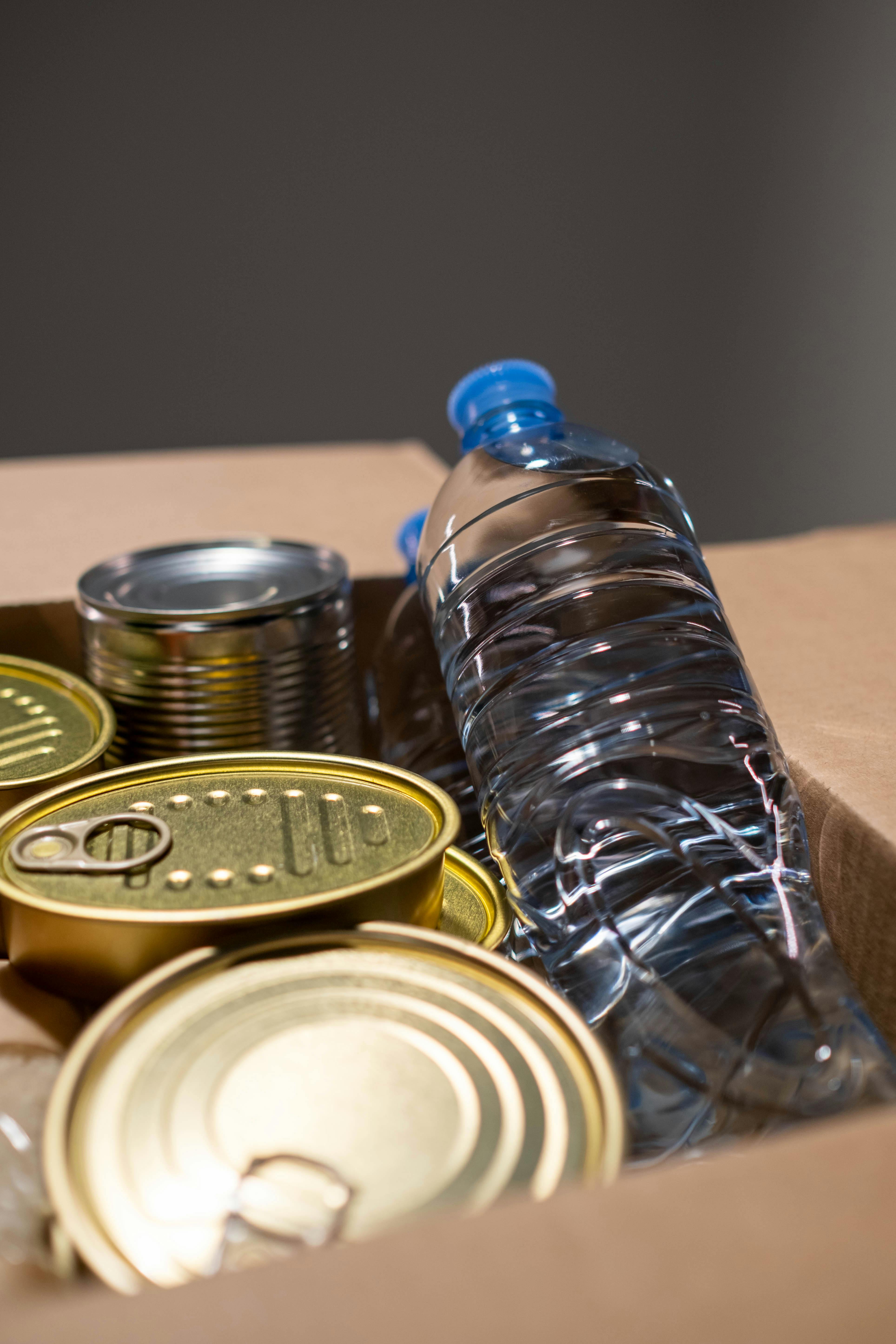
Canned food and water packed for an emergency. Stock photo. Photo: cottonbro studio, Pexels.
The tax change nobody told you about
Florida used to run a two-week disaster preparedness tax holiday each spring, and older guides still tell you to wait for it. Do not wait. Under the Department of Revenue's guidance (TIP 25A01-05), the following are exempt from sales tax all year, effective August 1, 2025: batteries in AA, AAA, C, D, 6-volt, and 9-volt sizes; ground anchor systems and tie-down kits; EPA-registered insect repellent meant for skin; Coast Guard approved life jackets; portable gas or diesel cans of five gallons or less; engine-driven portable generators of 10,000 running watts or less; smoke detectors; carbon monoxide alarms; fire extinguishers; sunscreen that is not a cosmetic; waterproof tarps and sheeting up to 1,000 square feet; and bicycle helmets. One surprise, because everyone assumes the opposite: flashlights are not on the exempt list. Lanterns and flashlights are still worth buying first, you just pay the tax on them. The exemption follows the item, not the store, so it applies at any Florida retailer.
Kitchen and water: the seven day core
Seven days, per person, no cooking required if the power and gas both fail. That means water at a gallon a day per person as the working rule inside the state's seven day guidance, food that opens by hand and eats cold, and a manual can opener that does not live in a drawer you cannot find in the dark. Shop it as a shelf, not a pile: water storage containers, a manual can opener, and shelf-stable food your household will actually eat in a normal month, rotated through the pantry so nothing expires in place. Baby formula, pet food, and prescription backups belong on this list for the households they apply to, counted in days the same way.
Light, power, and air: the comfort layer
Outages in Miami are measured in days of heat, not hours of dark. The kit that matters: a battery lantern per main room, a headlamp per adult, spare batteries in the exempt sizes above, and charged power banks for phones, which become the household's radio, map, and bank branch during a long outage. A battery or hand-crank weather radio is the one old-fashioned item that earns its shelf space, because it works when the networks do not. Fans that run on batteries or USB power turn a 90-degree bedroom from a health question into a bad night. Comfort is not a luxury category in a Miami outage. It is the category that decides whether you stay safely or drive somewhere you should not.
The generator rule: outside, 20 feet, no exceptions
If your home will run a portable generator, learn the carbon monoxide rule before the machine is ever fueled. The CDC's guidance is exact: never run a generator inside a home or a garage, even with doors and windows open, and run it outside, more than 20 feet from any window, door, or vent. Carbon monoxide kills more people after Florida storms than wind does in many seasons, and it does so silently, in houses that survived the hurricane itself. Pair the generator with the exempt carbon monoxide alarms on every floor, test them when the kit is built, and treat the fuel cans, five gallons or less to stay inside the tax exemption, as a storage decision: outside the living space, away from the water heater, in the smallest quantity that runs your plan.
Owners set up the building; renters set up the file
Owners work a building list in the spring: know your shutters or impact windows and test the hardware before June, photograph every room and the roof documentation your insurer will want, and keep the wind mitigation file from our insurance guide with the policy. Renters work a shorter building list and a longer paper one. Confirm in writing who handles shutters for your unit, because the answer varies by lease and building, and buy contents flood cover early if you are taking it: renters can insure contents up to $100,000 through the national program, and the standard 30 day waiting period means a policy bought in a storm week covers the next storm, not this one. Both groups do the same document day: scan the policies, the lease or deed, IDs, and the photo inventory to cloud storage, and put the county's number in the phone.
Sign up for the county systems now
Two registrations close the setup. Miami-Dade Alerts sends emergency information by text or email, including weather warnings and protective actions, through a free county account. Residents who would need help leaving, because they rely on specialized transportation or medical evacuation support and live at home, should register for the Emergency and Evacuation Assistance Program, the EEAP: apply once, online, by mail, or through 311, and the enrollment is lifelong, but registration closes before an evacuation order is issued, which is another way of saying a storm week is too late. The program's support line is 305-513-7700. Residents of assisted living facilities and nursing homes are covered by their facilities instead and do not qualify. Everyone else saves 311, and 305-468-5900 from outside the county, and reads our hurricane season planning guide for the visitor-side version of the same season.
The facts that matter
Hurricane setup facts checked November 8, 2026: the season runs June 1 to November 30 (NOAA). The state kit baseline is at least seven days of food and water per person (Florida Division of Emergency Management). Disaster supplies listed on this page are permanently Florida sales tax exempt since August 1, 2025 under Department of Revenue TIP 25A01-05; flashlights are not on that list. Generators run outdoors only, more than 20 feet from windows, doors, and vents (CDC). The county assistance registry is the Emergency and Evacuation Assistance Program; apply once through miamidade.gov or 311, support line 305-513-7700.
Frequently asked questions
When should the kit be finished?
Before June 1, and January is the smart month to build it: full shelves, no lines, and the tax exemption already in force. Our first 90 days checklist slots the build into a winter move.
Is there still a tax holiday week to wait for?
No. The exemption is permanent and year-round for the listed items, which replaced the old short holiday. Waiting costs you the January stock, not the tax.
What is the one step people skip?
The document scan and photo inventory. It takes an afternoon, it cannot be done after a roof fails, and it is the difference between a claim that pays and a claim that argues.
Keep planning
Next steps: the insurance cost guide, the address flood and surge check, the first 90 days checklist, and the moving to Miami hub.